When a commercial chain link fence starts showing bent top rails or gaps where rail sections are missing, the problem is rarely cosmetic. The top rail is a structural element that ties the entire system together, and damage to that component affects how the fence performs under load, how well it controls access, and whether it continues to meet the expectations that justified installing it in the first place.
For commercial properties in Reno and Northern Nevada, these issues often develop through a combination of operational impacts and environmental stress. Understanding what causes top rail damage, how it affects the broader fence system, and what repair approaches make sense for commercial sites helps property managers and contractors address the problem correctly rather than deferring it into a larger failure.
What the Top Rail Does in a Commercial Chain Link System
The top rail provides continuous horizontal support across the fence line. It keeps the chain link fabric tensioned, distributes loads between posts, and ties the entire system into a unified structure rather than a series of loosely connected panels.
When the top rail is intact and properly aligned, the fence maintains a uniform line. Fabric stays taut. Posts share loads rather than carrying them in isolation. The system resists impacts and lateral forces as a connected whole.
In taller commercial and security fences, this continuity matters more. Deformation in a single top rail segment increases stress on adjacent posts, rail connectors, and the fabric itself. The system depends on that horizontal connection to function as designed.
For yards, industrial sites, and utility enclosures, the top rail is not a minor finishing piece. It is a key part of the fence’s structural integrity and security performance.
Common Causes of Bent Top Rails
Impact loading is the most frequent cause. Forklifts, trucks backing into perimeter lines, equipment booms, and repeated contact from carts or pallets stored against the fence all contribute. A single impact can deform a top rail or lean a post. Repeated contact accelerates the damage and can propagate into adjoining sections.
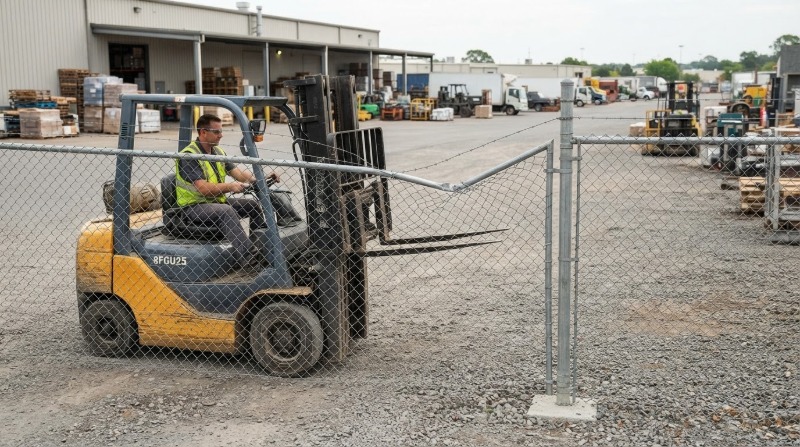
Excessive loading and misuse also play a role. People climbing the fence or using the top rail as a support bar apply forces the rail was not designed to handle. Temporary attachments like signage, netting, tarps, or materials placed against the fence load the rail and fabric in ways that cause gradual deformation.
Corrosion weakens rail wall thickness over time, making the pipe more prone to bending under moderate loads. In Northern Nevada’s climate, freeze and thaw cycles can shift posts through soil movement, misaligning the rail and fabric. The rail itself may not be the initial failure point, but the resulting misalignment can appear as a bent or sagging rail.
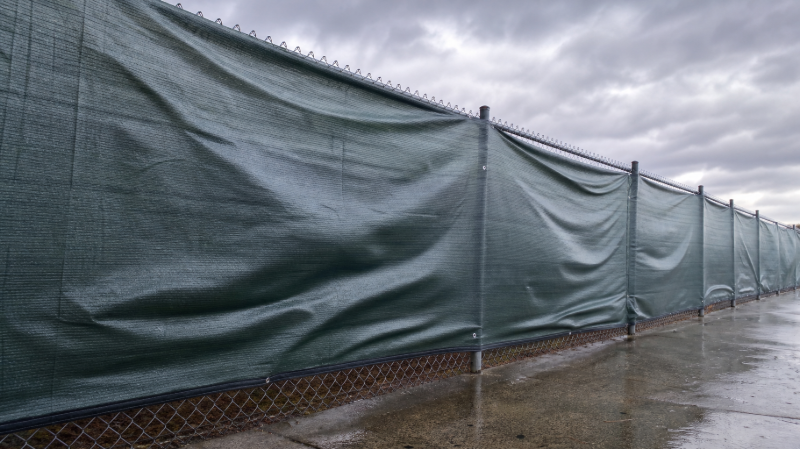
Wind loading on attached screens or privacy materials adds sustained lateral force to the system. When those forces concentrate at connection points or across spans with reduced wall thickness, bending follows.
Common Causes of Missing Rail Sections
Missing rail sections typically result from prior partial repair or removal. Damaged rail gets cut out and never replaced, leaving an open span. Sections are removed temporarily for equipment access and not reinstalled afterward.
Progressive failure also contributes. Severe impact or corrosion leads to breakage. The damaged section is removed to eliminate a hazard, but replacement gets deferred. A failed splice or rail sleeve is removed and not reconnected, leaving a gap in continuity.
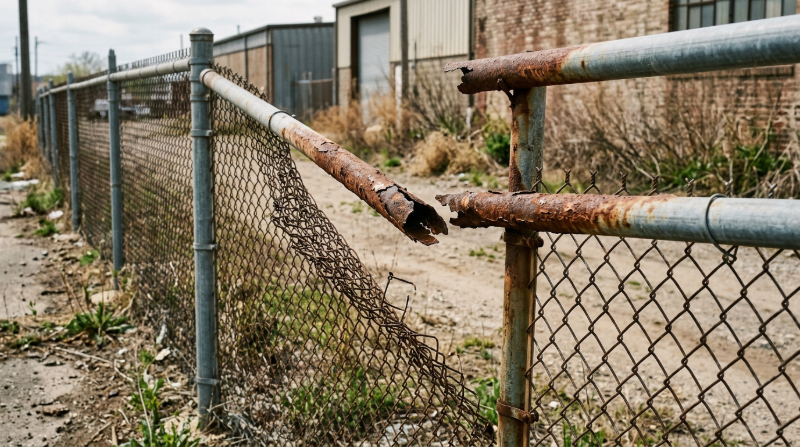
In some cases, operators remove sections intentionally to create improvised access points or openings for hoses, conduits, or changed circulation patterns. This typically undermines security and code intent where the fence was originally specified as a continuous barrier.
On commercial sites in Reno and Northern Nevada, these problems often intersect with seasonal climate stresses and equipment related impacts, given the mix of industrial, yard, and commercial storage use in the region.
Structural Effects of Top Rail Damage
A bent top rail reduces its ability to maintain tension across the fabric. The result is sagging and localized slack. Once tension is lost, loads are no longer evenly shared by multiple posts.
Isolated posts and fittings carry higher stress, increasing the risk of loosened ties and hardware, leaning or deflected posts, and progressive damage into adjacent panels.
In taller commercial and security systems, deformation in one area has a magnified effect. Increased stress on adjacent components can contribute to a chain reaction of failures during subsequent impacts or heavy winds.
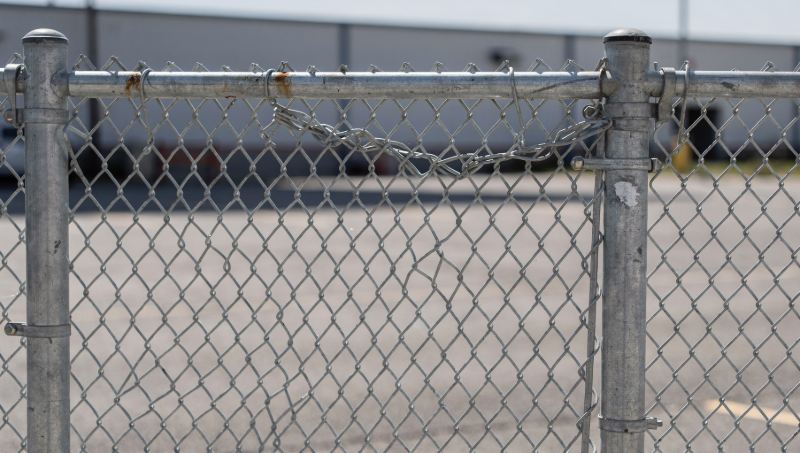
Missing rail sections create a discontinuity in structural support. Fabric in the gap is supported only by ties to posts or tension wire, not by a continuous rail. This results in pronounced sagging, soft spots in the fence line, increased risk of further tearing, and compromised ability to resist lateral loads.
Bent rails often correlate with shifted or leaning posts, especially when the impact or load was transmitted through the fabric. Stressed or elongated bolt holes at rail ends and brackets reduce clamping capacity and cause loose connections. If posts are out of plumb but the rail is forced back into alignment without correcting the post, stresses can concentrate at sleeves and end fittings, leading to repeat failure or sleeve slippage.
Security and Access Control Implications
For commercial and security focused sites, bent and missing top rails affect access control in practical ways. Sagging fabric below a bent rail is easier to climb, push down, or deform further. Missing rails can leave partial openings that can be widened with modest force, or unreinforced fabric spans that can be cut or pried away from posts more easily.
A visibly damaged or open fence line signals lax maintenance and may embolden attempts to test the perimeter, especially where the fence protects higher value assets like equipment, inventory, or secured yards.
When rails are bent or removed, wire ties in the affected area are often missing or widely spaced. This increases the ease of fabric separation and further reduces the barrier’s effectiveness.
For commercial operations with specified security or insurance requirements, these conditions can undermine the intended performance of the security fence, even if the overall line remains present.
Safety, Liability, and Compliance Considerations
Bent rails and missing sections can create safety and liability concerns, particularly around public access, employees, and equipment operations.
Damaged fence components can introduce sharp edges from bent or broken rails, cut fabric, and exposed wire ties. Catch points for clothing or equipment increase minor injury risk. Trip hazards can develop around partial dismantling or irregular mesh.
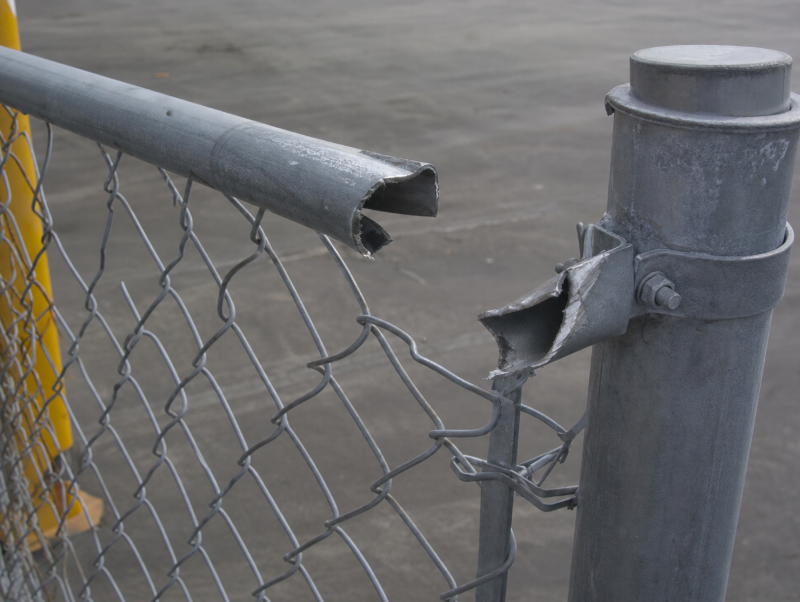
Openings from missing rails may allow unauthorized or unintended access, including pedestrian entry into restricted yards or wildlife and unauthorized vehicles where the fence was part of a controlled boundary.
General OSHA safety principles require employers to maintain workplaces free of recognized hazards likely to cause injury. While OSHA does not typically specify chain link top rails by detail, damaged perimeter fencing that creates sharp hazards or uncontrolled access to dangerous areas can fall under general duty expectations in industrial and construction settings.
Where fences are part of fall protection, public safety barriers, or restricted zone demarcation, damaged sections can conflict with the intent of codes or site safety plans, even when not explicitly detailed in regulation.
Commercial fences in Reno may also be subject to project specifications, contract documents, or owner standards requiring maintained perimeter integrity. Insurance conditions for secured storage or laydown yards often require functional barriers. Municipal expectations may apply where fencing forms part of public facing boundaries or screens. In these contexts, bent or missing rails can be treated as non-compliant conditions requiring timely correction.
Deciding Between Straightening and Replacement
Assessment before repair should include walking the fence line and identifying all damaged areas, not just the obvious bent or missing sections. Damage often propagates beyond the initial point of failure. Classify what you find: top rail issues, post issues, fabric issues, and corrosion or aging hardware.
For minor bends or gradual sagging where the rail wall thickness is intact and the bend is smooth rather than kinked, careful straightening may be appropriate. This involves detaching ties from the bent section, removing or loosening rail ends from brackets, laying the rail on a flat surface, and using a pipe bender or mallet to restore alignment.
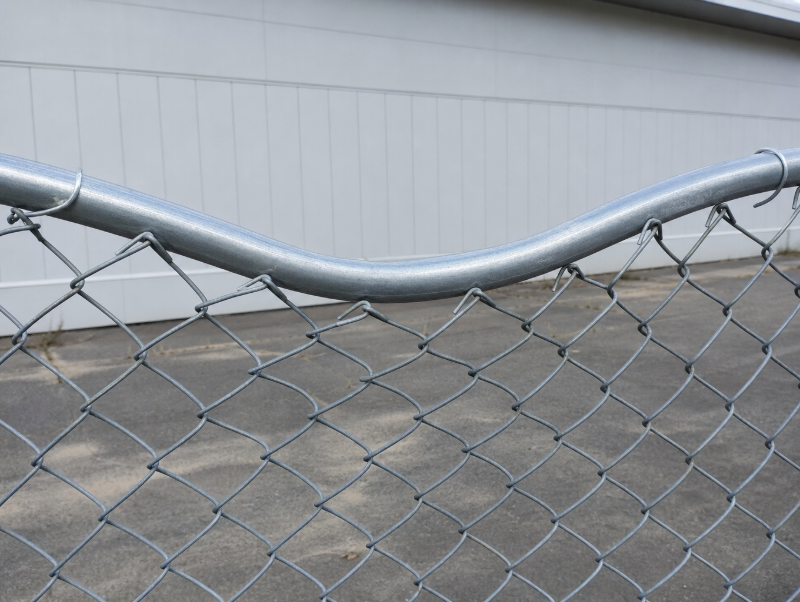
For severe bends or kinks, replacement is generally the better approach. Kinked steel loses strength and may not fully recover. Straightening can leave hidden microcracks or thin spots at bends. Replacement restores original design capacity and alignment.
For commercial sites where reliability and documentation matter, replacement of severely bent rails is generally more defensible than relying on re-straightening. Predictable performance and easier inspection sign-off favor new material over reworked components.
Typical Repair Procedures
For severely bent top rails, the repair sequence begins with isolating the damaged area. Remove wire ties connecting fabric to the bent top rail in the affected span. Remove ties from adjacent posts if needed to relieve tension.
Disconnect the rail from posts by loosening or unbolting rail ends at terminal and line posts. Slide rail ends or brackets off to free the bent section.
Cut out the damaged section by identifying where the pipe is still straight and cutting on either side of the bend with a reciprocating saw or pipe cutter. Square cuts make for cleaner connections.
Install the replacement rail by fitting the tapered end of new rail into the existing section or using sleeves to connect straight ends. Slide or position rail end brackets and secure them to posts with appropriate hardware.
Reattach fabric by retying it to the new rail using wire ties at proper spacing. Confirm tension and alignment along the entire section.
For missing top rail segments, the process is similar but begins by confirming adjacent rail ends and posts are structurally sound and correctly aligned. Cut back any irregular or corroded ends to clean, straight pipe. Insert a new rail segment sized to close the gap using tapered joints or sleeves. Re-secure rail ends to brackets on posts. Reattach fabric and ties to restore uniform tension and eliminate gaps.
For commercial work, the key differences are scope and documentation. Repairs may need to be coordinated with site operations, access control, and shutdowns. Larger runs or taller fences often require additional bracing or temporary supports during repair. Owners or general contractors may require photographic documentation or test sections to confirm performance.
Considerations for Northern Nevada Commercial Sites
The Reno context introduces practical variables that affect both damage patterns and repair timing.
Snow, freeze and thaw, and wind loads can contribute to frost heave affecting posts and bracing. Additional stress develops on rails where screens or tarps are used for snow or wind control.
Repair planning often must consider timing around weather, avoiding cutting and fit-up when posts are moving due to thaw. Evaluation of foundations and posts in addition to rails is typically necessary.
Yards, industrial sites, and mixed commercial storage create conditions where forklifts, trucks, and heavy equipment routinely operate near fence lines. This increases impact risk. Bent or missing rails may be symptomatic of operational practices like turning radii, stacking patterns, or using the fence for temporary support. These situations require procedural adjustments, not just physical repair.
Commercial owners, property managers, and general contractors typically expect clear classification of damage as isolated or systemic. Repair scopes should address both immediate problems and adjacent vulnerabilities like weakened fittings in nearby panels. How repairs interface with existing documentation, specifications, or security requirements matters for project closeout.
Working With a Contractor Who Understands the Full Picture
Top rail damage in commercial chain link fences is rarely an isolated problem. Addressing it properly means understanding the structural role of the rail, the forces that caused the damage, and what else in the system may have been affected. It also means coordinating repairs with site operations and documenting the work in ways that satisfy project requirements.
A1 Fence LV works with general contractors, property managers, and commercial property owners throughout Reno and Northern Nevada on perimeter repairs that account for the region’s climate conditions and the operational realities of commercial sites. The company brings experience from large scale commercial projects as well as the practical understanding that comes from working through every level of the trade.
If you are evaluating damage to an existing fence line or coordinating repairs as part of a larger site plan, you can request a quote online at https://a1fencelv.com/request-a-quote. For direct coordination, reach Lalo Flores at 775-451-3328 or lalo@a1fencelv.com.
source https://a1fencelv.com/bent-top-rails-and-missing-rail-sections-in-commercial-chain-link-fences/

No comments:
Post a Comment