Slide gate tracks become misaligned when the track, wheels, and gate frame no longer share the same straight, level path. This typically happens because of debris accumulation in the track, shifting foundations, worn wheels, or bent steel from impact or stress. When misalignment develops, the gate starts to drag, bind, or move unevenly instead of traveling smoothly.
Understanding what causes these problems helps property owners recognize early warning signs and respond before a minor issue turns into a costly repair. For a broader look at how automatic gate systems work together, you can visit our automatic gates overview.
How a Sliding Gate Track System Actually Works
A sliding gate track system relies on wheels or rollers running along a fixed steel track to guide the gate in a straight line during opening and closing. The track itself is anchored to a concrete foundation, and the gate frame rides on top of it through a set of wheels positioned at specific points along the gate’s length. When everything is aligned properly, the gate glides with minimal resistance and stays centered in its travel path.
In practice, the track is just one part of a larger mechanical system. The gate frame, support posts, wheels, ground foundation, motor, drive gear, and safety hardware all have to work together. If any of these components shifts, wears, or becomes obstructed, the relationship between the track and gate changes.
For automatic gates, this alignment is especially critical. The operator pushes or pulls the gate along the track, and it expects consistent resistance throughout the travel. When the track or wheels are out of line, that resistance changes unpredictably. The motor has to work harder, cycle times increase, and the system experiences stress it was not designed to handle continuously.
In Northern Nevada, where freeze thaw cycles and ground movement are common, the foundation under a track can shift over time. Soil expands when it freezes and contracts when it thaws. Over several seasons, this movement can push or pull the track out of its original position, even if the initial installation was precise.
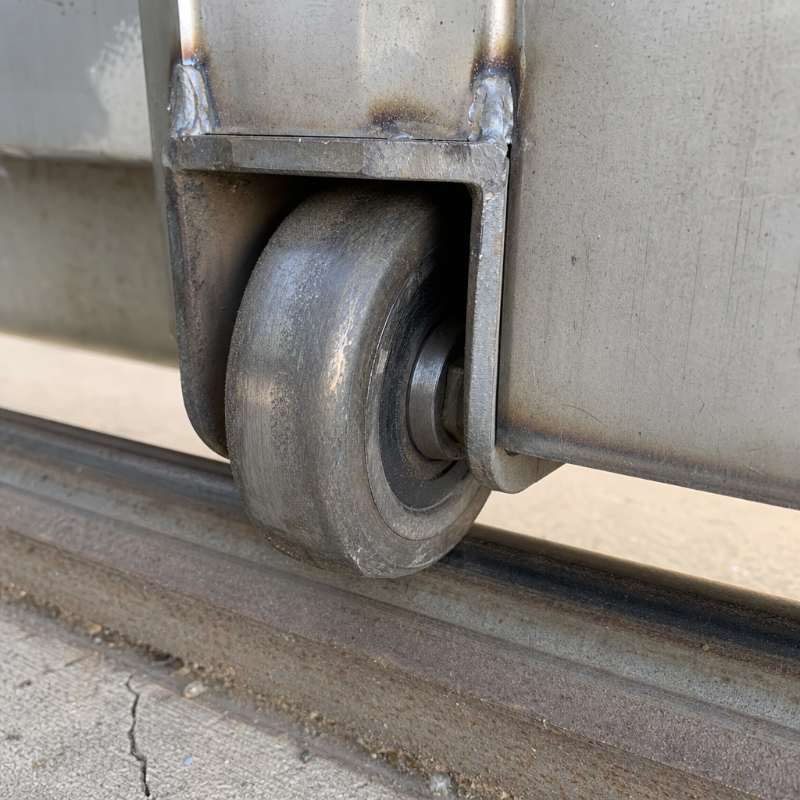
The wheels themselves also play a role in maintaining alignment. They sit in the track groove and keep the gate centered. When the wheels wear unevenly or develop flat spots, the gate starts to ride differently. It may lean to one side, bounce, or try to climb out of the groove entirely.
Common Causes of Track Misalignment
Dirty or obstructed tracks are one of the most frequent causes of misalignment. Gravel, leaves, ice, and wind blown debris collect in the track groove over time. When the wheels roll over these obstructions, they ride up, twist, or skip. Repeated contact with debris gradually pushes the wheels and track out of their intended relationship.
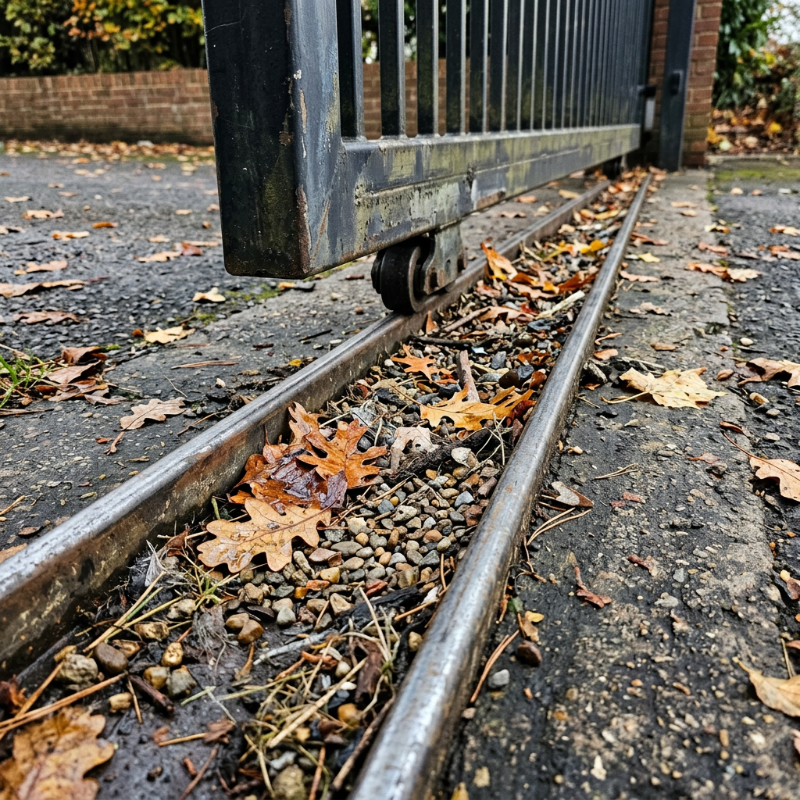
In Reno and surrounding areas, seasonal debris is a constant factor. Fall brings leaves and organic material. Winter brings snow, ice, and road grit. Spring runoff can deposit sand and sediment. Each season introduces new material into the track, and without regular cleaning, buildup accelerates wear and creates alignment problems.
Improper or shifting installation is another major contributor. If the track was not set straight and level during installation, or if the concrete foundation was not deep enough to resist ground movement, the track will eventually migrate. Even a small shift of a fraction of an inch can change how the wheels ride and cause binding at certain points in travel.
Worn or damaged wheels change how the gate sits on the track. Over time, the groove in each wheel wears down or develops flat spots from repeated rolling. When the wheel profile no longer matches the track profile, the gate starts to ride differently. It may pull to one side, vibrate, or make contact with parts of the track it should not touch.
Bent or damaged track sections force the wheels into a crooked path. Vehicle contact is a common cause of bent track, especially on driveway gates. Even a slow speed bump from a car backing up can bend the steel enough to affect alignment. Once the track is bent, every cycle pushes the wheels through that deformation, accelerating wear on both components.
Load and weight issues also contribute. If the gate is heavier than the wheels and track were designed to support, the extra load compresses components and changes tolerances over time. Gates with added decorative elements, security features, or accumulated ice and snow can exceed the original design capacity without anyone noticing until problems appear.
What Misalignment Looks Like in Daily Use
When a slide gate track becomes misaligned, the first sign is usually a change in how the gate feels or sounds during operation. Movement that was once smooth becomes rough, tight, or uneven. The gate may hesitate at certain points in travel or stop short of its fully open or closed position.
Property owners often describe the gate as “sticky” or “jerky.” These descriptions point to resistance changes along the track. The wheels may be hitting debris, climbing a bent section, or dragging against the groove wall. Each of these causes creates a similar symptom but requires different correction.
On automatic systems, misalignment often triggers nuisance faults. The operator senses increased resistance and interprets it as an obstruction. Safety systems designed to prevent the gate from closing on a person or vehicle activate because the force required to move the gate exceeds programmed limits. The gate stops, reverses, or refuses to complete its cycle.
In cold weather, these problems become more pronounced. Ice can form in the track overnight, creating hard obstructions. Grease on the wheels thickens and provides less lubrication. The combination of mechanical misalignment and cold weather resistance can make a gate that worked fine in summer nearly unusable in January.
Visible signs also appear over time. Gaps between the gate and posts may become uneven. The gate may sit crooked when fully closed. In severe cases, the wheels visibly ride up on the track edge or partially leave the groove. These are late stage symptoms that indicate misalignment has progressed significantly.
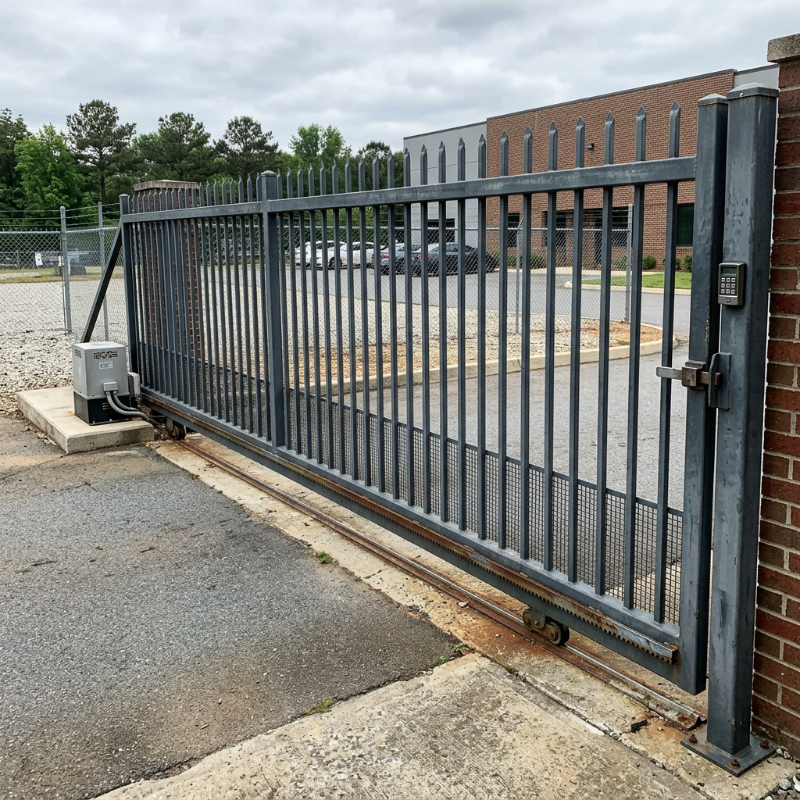
Running a gate on a misaligned track accelerates wear throughout the system. The wheels grind against surfaces they should not contact. The track deforms further under uneven loading. The operator strains against resistance it was not designed to overcome continuously. What starts as a minor adjustment eventually becomes replacement of multiple components.
Common Misunderstandings About Track Alignment
Many property owners assume that once a sliding gate is installed, it should remain aligned indefinitely with little or no attention. In practice, track systems are sensitive to debris, wear, and ground movement. They require periodic inspection and cleaning to maintain proper alignment.
Another common assumption is that any gate problem must be electrical or motor related. When an automatic gate stops working correctly, the first instinct is often to check the remote, the control board, or the power supply. In reality, many automatic gate problems start with simple mechanical issues. A dirty track, worn wheels, or minor misalignment can cause symptoms that appear to be electrical failures.
Some property owners also believe that as long as the gate still moves, scraping and binding are harmless. They tolerate rough operation because the gate technically functions. This approach overlooks the progressive nature of misalignment. Every cycle on a crooked track wears components further. The cost of correction increases as the damage spreads from the track to the wheels to the operator.
There is also a tendency to underestimate environmental factors. In Northern Nevada, the combination of temperature swings, moisture, and wind creates challenging conditions for any outdoor mechanical system. A track that performs perfectly in mild weather may develop problems when ice forms, ground shifts, or debris accumulates over a harsh winter.
Understanding that a sliding gate is a system helps set more realistic expectations. Track alignment, wheel condition, structural integrity, and environmental exposure all interact. Addressing one factor while ignoring others often provides only temporary improvement.
When Professional Evaluation Makes Sense
Questions about misaligned sliding gate tracks often come up when someone contacts an automatic gate specialist because their gate has become hard to move, keeps stopping midway, or has come off its track entirely. Diagnosing whether the issue is in the track, wheels, structure, or operator usually involves looking at the system as a whole rather than isolating individual parts.
A gate that has derailed or shows significant structural damage is not something most property owners can safely correct themselves. Attempting to force a gate back onto a bent track or operating a system with severely worn wheels can worsen the damage or create hazards. The weight and momentum of a sliding gate make improper handling risky.
Seeing track misalignment as a gradual mechanical process influenced by debris, wear, and environmental factors helps property owners recognize early warning signs. A gate that feels rougher than it used to, stops inconsistently, or shows visible gaps is communicating something about its condition. Responding to those signals before they escalate keeps correction costs manageable and extends the service life of the overall system.
For properties in Reno and surrounding Northern Nevada, A1 Fence LV works with automatic gate systems across residential and commercial applications. Zachary Thompson brings more than 25 years of hands on experience with gate fabrication, operator selection, and access control integration. That background includes evaluating systems for long term durability under seasonal stress, which matters in a climate where freeze thaw cycles and ground movement are part of normal operating conditions.
If you are considering repairs, upgrades, or a new installation, submitting a quote request online is the simplest place to start at https://a1fencelv.com/request-a-quote.
If you would like to discuss your property or project directly, Zachary can also be reached at (775) 451-3328 or zac@a1fencelv.com. A site-specific evaluation can help determine what makes the most sense for your property’s layout, operating demands, and long-term reliability.
source https://a1fencelv.com/what-causes-slide-gate-tracks-to-become-misaligned/

No comments:
Post a Comment