Automatic gates improve commercial property security by controlling when and how vehicles enter a property, directing traffic through specific access points, and creating a visible barrier that discourages casual intrusion. The real security value depends on how well the system matches the site, how consistently it performs in actual operating conditions, and how people interact with it day to day. For commercial properties in Reno, that means accounting for seasonal weather, heavy use cycles, and the practical realities of keeping a motorized system running reliably over time.
Understanding what automatic gates actually do, and what they do not do, helps set realistic expectations about the protection they provide. This article explains how these systems work in practice and what affects their performance on commercial sites in Northern Nevada. For broader context on fencing and access control options, A1 Fence LV provides additional resources.
What an Automatic Gate Actually Does on a Commercial Property
An automatic gate on a commercial property is a motorized system that controls vehicle entry through a combination of the gate itself, an operator that moves it, supporting hardware like tracks or hinges, and some form of access control that determines who can open it and when.
In practical terms, the gate does not secure the entire property on its own. It manages vehicle access at specific points.
That means slowing entry so every vehicle has to stop and authenticate, whether through a keypad code, card reader, remote, or intercom. It means channeling traffic through predictable locations that can be monitored, logged, or observed.
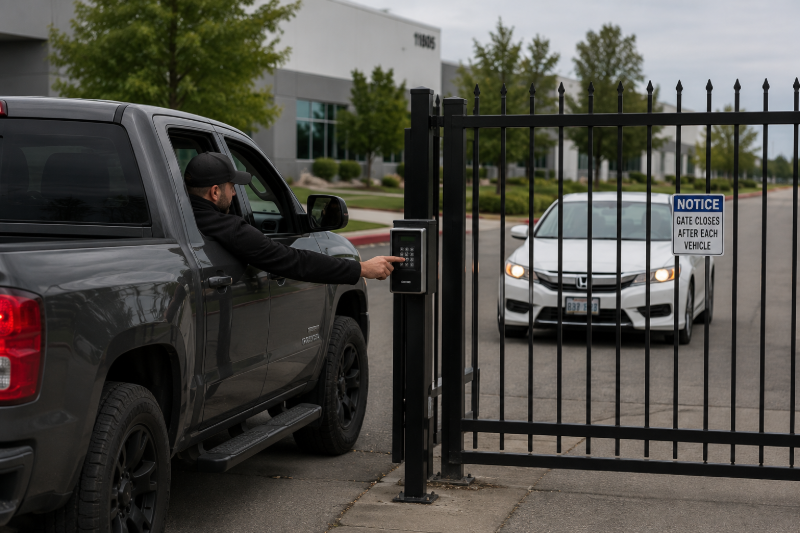
The visible barrier also discourages casual drive-through access. Someone looking for an easy target will often move on when they see a closed gate rather than an open lot.
Different gate configurations behave differently depending on the site. Sliding gates work well in tight spaces but need clear track areas. Swing gates require room to arc open and can catch wind on solid panels. Cantilever systems avoid ground track issues but need more lateral space and heavier posts.
For commercial properties, the hardware is typically heavier than residential setups. Posts, hinges, rollers, and operators are sized for gates that weigh more and cycle more often throughout the day.
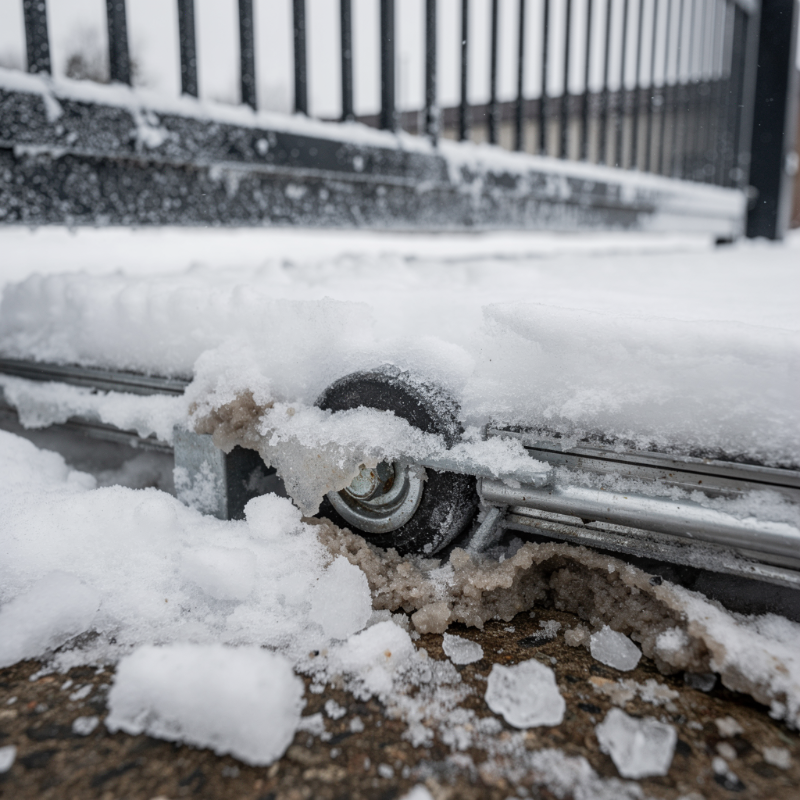
In Reno, real-world operation is shaped by temperature swings, snow and ice accumulation around tracks and hinges, dust from dry summers, and ground movement from freeze-thaw cycles. Each of these factors affects how smoothly the gate opens and closes over weeks, months, and years.
The gate is one layer in a broader security approach. Without coordinated pedestrian control, proper lighting, and clear access policies, the gate addresses only part of the picture.
Why Reliability Determines How Much Security You Actually Get
The security value of an automatic gate depends almost entirely on whether it works when it needs to.
When a gate fails, runs slowly, or triggers constant nuisance stops, people find workarounds. Staff prop it open during busy periods. Drivers push against it when they get impatient. Someone switches it to manual mode and forgets to switch it back. At that point, the gate is no longer controlling access. It is just an obstacle in the driveway.
Safety devices like photo eyes and sensing edges are essential to preventing injuries and damage. They stop the gate from closing on vehicles or people. But when those devices get dirty, misaligned, or damaged, they can trigger stops or prevent the gate from closing at all.
Users often experience this as “the gate not working” even though the system is doing exactly what it should, which is refusing to move when it detects an obstruction. The problem is that dirty or drifting sensors create false positives, and that erodes confidence in the system.
Durability of the structure matters just as much. Hinges, rollers, tracks, operators, and posts that are sized correctly for the weight of the gate and the local wind and weather tend to hold alignment longer. That means fewer repairs, fewer stuck-open situations, and more consistent security performance over time.
Long-term cost is part of this equation. Commercial automatic gates carry ongoing needs, including inspection, lubrication, adjustment, and periodic part replacement. Systems matched correctly to duty cycle and conditions usually have fewer disruptions and lower lifetime cost than undersized or improvised setups that fail more often.
Access habits quietly affect security as well. Shared codes that never change, remotes in the hands of former employees, tailgating vehicles that slip through behind authorized users, and unsecured pedestrian routes all reduce the control the gate is supposed to provide. These are access control problems, not gate hardware problems, but they directly undermine what the system is meant to accomplish.
Misunderstandings That Lead to Disappointment
A common belief is that installing an automatic gate “secures” the property. In practice, the gate only manages vehicle access at specific points.
If there are open pedestrian paths, low adjacent fencing, or poor lighting, determined intruders will find easier ways in. The gate does not address those vulnerabilities. Expecting it to function as a complete security solution leads to disappointment when it does not.
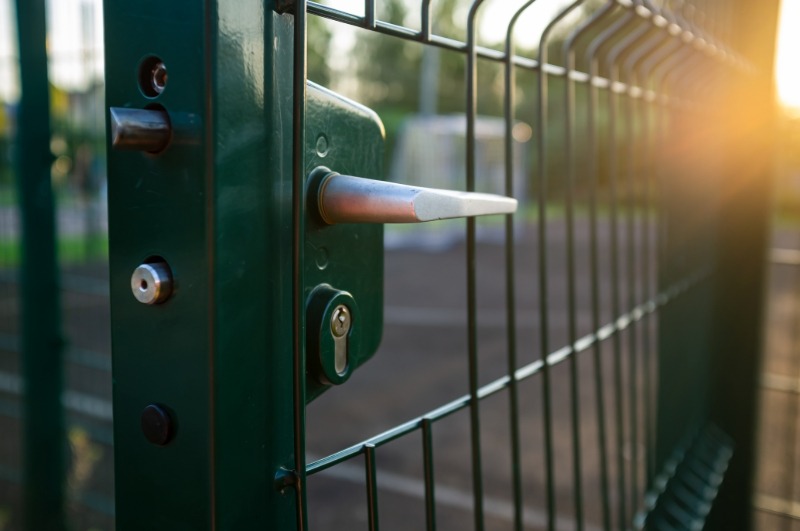
Another widespread assumption is that automatic gates are maintenance-free once installed. Moving steel, motors, and exposed electronics in an outdoor commercial environment will need periodic attention.Hinges wear. Rollers collect debris. Tracks shift. Operators cycle thousands of times and eventually need service. Ignoring these realities turns minor wear into alignment problems, sensor faults, and sudden lockouts that can leave the gate stuck open at the worst time.
There is also frequent confusion between the physical gate and the access control system that tells it when to move. When an old code still works or a former tenant still has a working remote, that is not a gate failure. It is an access control management issue.
The gate hardware did its job. The problem is that the credentials were never revoked. Blurring this distinction leads to misplaced blame and missed opportunities to tighten actual security.
Finally, there is a habit of treating all operators as interchangeable. On busy commercial sites with frequent ins and outs, undersized operators are more likely to overheat, fault, or be left in manual mode because they cannot keep up with demand.
That removes most of the security benefit the gate was supposed to provide. Matching the operator to the duty cycle matters more than many property managers realize.
How This Plays Out on Commercial Properties in Reno
On a typical Reno commercial property, an automatic gate manages employee parking, deliveries, and after-hours access. It cycles more heavily at shift changes and remains closed overnight to limit casual drive-throughs.
Over time, common issues develop. Gates sag or go out of alignment from stressed hinges or shifting posts. Tracks get obstructed by snow, gravel, or debris. Operators fault because of worn components or neglected safety devices.
When performance gets inconsistent, behaviors follow. Staff prop gates open during peak traffic. Drivers push on a gate that has not fully cleared. Users try to defeat safety features they see as nuisances.
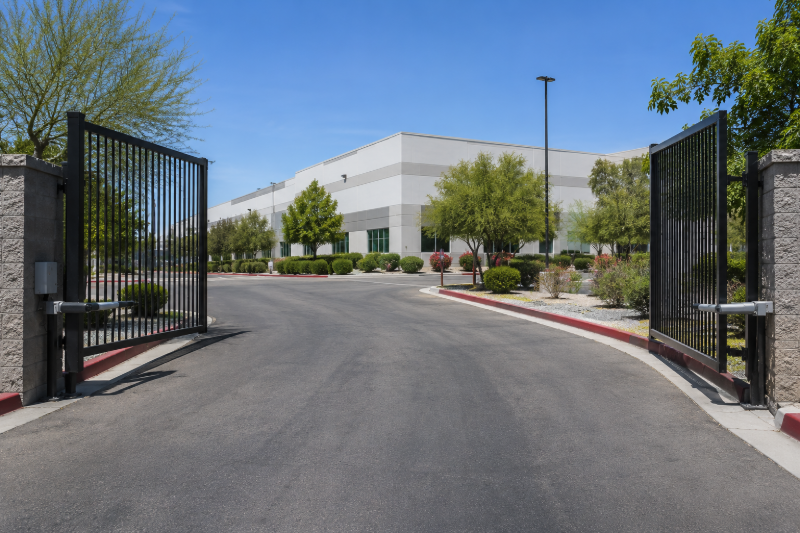
Many automatic gates on commercial properties end up operating for stretches of time in a compromised state. A gate left open after an impact. A system running with partially functioning safety devices. Access control that has not been updated in years.
These situations change the level of security the gate provides without always being obvious to everyone on site.
In Reno’s climate, winter conditions add another layer. Snow and ice can build up around tracks and bottom edges. Cold temperatures thicken lubricants and slow operators. Ground movement from freeze-thaw cycles can shift posts and throw alignment off.
These are not rare events. They are seasonal realities that affect how reliably the gate performs through the year.
Properties that plan for this, with regular inspection cycles and prompt attention to developing issues, tend to get more consistent security value from their automatic gates. Properties that run gates until something breaks tend to experience more disruptions and more situations where the gate is not doing what they expect.
What This Means for Commercial Properties in Northern Nevada
Automatic gates can significantly improve commercial property security by tightening control over vehicle access and discouraging casual intrusion. But the real value comes from understanding their operating limits, maintenance needs, and how they interact with people and weather over time.
Seeing the gate as one element in a larger system, rather than a complete security solution or a maintenance-free fixture, helps set more realistic expectations about how it will perform on a commercial site in Northern Nevada.
Questions about how much security an automatic gate really provides, why it behaves a certain way in cold weather, or how often it should be inspected usually come up when owners or managers are planning, adjusting, or repairing these systems. In a climate like Reno’s, where conditions shift seasonally, those conversations tend to be more productive when they start with an honest look at what the system can and cannot do.
For property owners and facility managers evaluating automatic gate options, or working through performance issues with an existing system, understanding how terrain, climate, and daily operating demands affect long-term reliability is an important part of the planning process.
Zachary Thompson serves as A1 Fence LV’s dedicated automatic gate specialist and brings more than 25 years of hands-on experience across fabrication, installation, operator selection, access control integration, distribution, sales, and field instruction. His experience includes evaluating automatic gate systems for long-term durability, mechanical performance, and safety integration in demanding operating environments throughout Nevada.
A1 Fence LV is a family-owned Nevada contractor founded in 2015 by Eli Maciel, who brings more than 35 years of industry experience. The company works with commercial and residential property owners throughout Northern and Southern Nevada to evaluate site conditions, match systems to real-world operating requirements, and plan for long-term performance.
If you are reviewing options for an automatic gate or access system, or dealing with an existing gate that is not performing as expected, submitting a quote request online is the simplest place to start. You can request a quote at https://a1fencelv.com/request-a-quote. If you would prefer to discuss your site directly, Zachary Thompson can be reached at (775) 451-3328 or zac@a1fencelv.com. Whether you are planning a new installation, evaluating upgrades, or trying to determine the cause of ongoing issues, a site-specific evaluation can help clarify what makes the most sense for your property and operating conditions.
source https://a1fencelv.com/how-automatic-gates-improve-commercial-property-security/

No comments:
Post a Comment